

Cotton is the fibre that grows on the seed of the cotton plant, Gossypium. Each fibre is a single cell, a hair on the seed coat, and when it dries it collapses into a flat, twisted ribbon of almost pure cellulose: about 95% at maturity and 99% after scouring and bleaching (Cotton Incorporated). That structure explains how cotton behaves. It is soft, absorbs moisture readily, takes dye well, and is stronger wet than dry, but it creases, shrinks unless finished, and burns easily. Its quality is judged by staple length, strength, fineness and colour, measured on every bale. It is the world’s main natural fibre: 24.5 million tonnes in 2023/24, about 19% of all fibre produced, according to Textile Exchange.
The questions readers ask come first: what cotton is and what it is made of, how it looks under a microscope, whether it absorbs, shrinks or burns, what makes Pima and Egyptian cotton different, how it compares with polyester, linen and wool, and how to wash it. Then the depth, with every figure sourced: measured properties, structure and chemistry, how cotton is graded on the HVI line, how it grows, is picked and ginned, where it is grown and what it costs, cotton in India, and its environmental record. Four of the site’s calculators are worked through, each with a link that opens the tool with the same figures entered.
Last verified: 6 October 2026. Sources are linked where they are used and listed at the end.

What is cotton?
EU labelling law defines cotton as “fibre obtained from the bolls of the cotton plant (Gossypium)” (Regulation (EU) No 1007/2011, Annex I). US law has no definition; “cotton” appears only as an example of a generic fibre name (16 CFR 303.6). Botanically, “Each fiber is an outgrowth of a single cell that develops in the surface layer of the cotton seed” (USDA, The Classification of Cotton).
Four species are grown. In the words of India’s government, “These include G. Arboreum and G. Herbaceum, commonly referred to as Asian cotton. The other species are G. Barbadense, known as Egyptian cotton, and G. Hirsutum, known as American upland cotton”, and India is the only country that grows all four (PIB, White Gold: India’s Cotton Story, July 2026).
- Upland, G. hirsutum, is about 95% of world production, chosen for its yield and adaptability (Grover and colleagues, BMC Genomics, 2025). US Upland fibres “normally are between 1.0 and 1.25 inches” long (Cotton Incorporated).
- G. barbadense is the extra-long staple (ELS) cotton sold as Pima, Egyptian (Giza) and Sea Island, with fibres “as long as 1.6 inches for Pima cotton”. ELS and long-staple cotton together are “around 1% to 2% of total world production”, 390,000 tonnes in 2024/25, and the definitions are “not globally standardized” (ICAC, Specialty Cotton Report, 2025).
- G. arboreum and G. herbaceum, the desi or Asian cottons, have “shorter fiber lengths, ½ to 1 inch” (USDA). They are coarse, hardy, and still grown in India.
What is cotton made of?
Mature raw cotton is 90 to 95% cellulose (Grover and colleagues). The rest is the protein, pectin, wax, sugars and mineral matter of what was a living cell, most of it in the outer skin. The wax matters: it makes raw cotton water-repellent, which is why cotton is scoured before it is dyed or sold as absorbent cotton, and “After scouring and bleaching, cotton is 99% cellulose” (Cotton Incorporated).
What does cotton look like under a microscope?
Along its length, “The cotton fiber, when observed in its entirety, is a flat, twisted ribbon, with 50 to 100 convolutions per inch” (Cotton Incorporated), about 20 to 39 twists a centimetre. In cross-section it is kidney- or bean-shaped, with a central canal, the lumen. The shape comes from drying: the growing fibre is a tube full of fluid, and when the boll opens “the lumen naturally collapses, leaving a central void, or pore space, in each fiber”. The bean shape needs “the desirable intermediary extent of secondary wall thickening” (Haigler and colleagues, Frontiers in Plant Science, 2012), and so it reads maturity: “Mature cotton fibres have thick walls and a small, discontinuous lumen” (Canadian Conservation Institute, CCI Notes 13/11).

Mercerisation changes the picture: caustic soda and tension make the fibre “swell, straighten, and become more cylindrical” (CCI), so mercerised cotton shows fewer twists and a rounder section. Wool, by contrast, is scaly and nearly round, and silk smooth; the site’s guide to the microscopic appearance of fibres compares them, and fibre identification tests add the burn test. Maturity is measured under the microscope to ISO 4912, by caustic swelling to ASTM D1442, or by image analysis to ASTM D8394.
Is cotton absorbent and breathable?
Cotton takes up moisture readily: its regain, the water it holds as a percentage of its dry weight, is 7% at standard conditions for bleached fibre (Cotton Incorporated), against 13.6% for wool and 0.4% for polyester (IS 13157). The EU’s agreed allowance, used for declaring fibre content, is 8.50%, and 10.50% for mercerised cotton (Regulation 1007/2011, Annex IX). The moisture regain calculator turns an as-received and an oven-dry weight into regain.
The claim that cotton “can absorb up to 27 times its weight in water” is repeated widely and has no standard behind it. The pharmacopoeia tests are for scoured, bleached absorbent cotton, which holds water in and between its fibres: not less than 23.0 g of water per gram in the European test (Ph. Eur. monograph 0036), and 24 times its weight in the US sinking test (Cotton Incorporated). Raw cotton, still waxy, repels water. A cotton fabric breathes mainly because air and vapour pass between its yarns; the air permeability calculator works with the test figures.
Does cotton shrink?
Yes, unless it has been stabilised. Woven and knitted cotton is stretched as it is made and finished, and the strain is released the first time it is wetted and dried, so the fabric shrinks once, mostly in length. Fabric sold as pre-shrunk has been mechanically compacted or relaxed so that little is left (see pre-shrinking finishes). Shrinkage is measured, not guessed: ISO 5077 measures dimensional change in washing and drying using the procedures of ISO 6330; the relaxation shrinkage calculator turns before-and-after measurements into a percentage, and the wash shrinkage calculator sizes a pattern for fabric that will still shrink.
Is cotton stronger wet or dry?
Wet. Cotton Incorporated gives bleached cotton fibre a strength of 27 to 45 g/tex dry and 30 to 54 g/tex wet, and notes that “the strength of cotton generally increases with increased moisture” (Cotton Incorporated, Table 3). From those ranges cotton is roughly 10 to 20% stronger wet, which is why it survives hot, vigorous laundering; the old figures of “10%” and “20 to 25%” on this site’s earlier pages each caught one end of that range. Viscose, also cellulose, does the opposite and loses strength when wet. Cotton stretches only 3 to 9.5% before it breaks, so it creases and does not spring back.
Is cotton flammable?
Yes. Cotton ignites at about 255 °C and has a limiting oxygen index of 18.4, below the 21% of oxygen in air, so once lit it keeps burning; wool, for comparison, ignites at 570 to 600 °C with an index of 25.2 (Woolmark, citing CSIRO). It does not melt. Heat damages it before it burns: “Long exposure to dry heat above 300°F (149°C) causes cotton fibers to decompose gradually, and temperatures above 475°F (246°C) cause rapid deterioration” (Cotton Incorporated). Cotton for protective clothing is given a flame-retardant finish; the FR LOI predictor starts cotton at about 18.5 and estimates the rise, and ASTM D5238 tests cotton batting for smouldering.
Pima, Egyptian and Sea Island cotton
All three are G. barbadense, the extra-long staple species. Longer fibres twist together with more contact along their length, so they spin finer, smoother and stronger yarns, which is what buyers of fine shirting and high thread-count sheets pay for. Pima is the American name; USDA’s handbook describes G. barbadense fibres from 1¼ to 1 9/16 inches, “known in the United States as ‘American Pima’ cotton, also commonly referred to as ‘Extra-Long Staple’ cotton”. Egyptian cotton is not the oldest cotton, as is sometimes claimed: Egypt’s famous long-staple type dates from its introduction in 1820 under Muhammad Ali (Owen, Proceedings of the British Academy, 1999). Because the names carry a premium, “Egyptian cotton” on a label is a claim about origin, worth checking against a certificate; the site’s guide to cotton varieties goes further.
Cotton vs polyester, linen and wool
| Cotton | Polyester | Linen | Wool | |
|---|---|---|---|---|
| Source | Seed hair, cellulose | Synthetic polymer | Stem fibre, cellulose | Sheep’s fleece, protein |
| Tenacity, cN/tex | 24–44 | 28–80, by grade | 40–80 | 8–18 |
| Elongation at break | 4–10% | 18–27% (apparel staple) | 1.2–3.2% | 25–40% |
| Commercial regain | 7.0% | 0.4% | 12.0% (raw flax) | 13.6% |
| Heat | Does not melt; ignites at about 255 °C | Melts at 250–260 °C | Does not melt | Does not melt; ignites at 570–600 °C |
| Limiting oxygen index | 18–18.5 | 20–21 | – | 25.2 |
| World production | 24.5 million t, 19% | About 59% of all fibre | About 0.3% | Under 1%, with other animal fibres |
Sources for the table: tenacity, elongation, regain, heat and LOI, the site’s sourced table of 34 fibres, with cotton’s ignition from Woolmark and wool’s from the IWTO; production, Textile Exchange’s Materials Market Report 2025. Each fibre has its own page: polyester, the fibre cotton is most often blended with; linen, its stiffer, crisper cellulose cousin; and wool.
How to wash and care for cotton
- Follow the label, not the fibre. GINETEX, which administers the care symbols, says the temperature “must be selected solely on the basis of the care label and not according to the fibre content” (GINETEX). White cotton marked for a boil wash can go to 95 °C; dyed and printed cotton usually less.
- Bleach is possible, carefully. Cotton resists alkali and oxygen bleach well, and chlorine bleach is tolerated by white cotton when the label allows it; acids, especially hot, damage it.
- Iron hot, while damp. Three dots on the iron symbol mean “maximum sole plate temperature of 210 °C. Corresponding to the ‘Cotton/linen’ setting” (GINETEX).
- Store it dry. Damp cotton mildews: “Mildew, a type of fungus, and some bacteria can cause odors, stains and decay”, and “Silverfish will eat cotton and flax if the fabric is starched” (CCI). Clothes moths are not a risk on their own: cotton is “rarely attacked unless blended with wool, or heavily soiled with food stains or body oils” (University of Kentucky).
Pros and cons of cotton
| Advantages | Drawbacks |
|---|---|
| Soft, and comfortable next to the skin | Creases easily: it stretches only 3 to 9.5% before breaking and recovers little |
| Absorbs moisture and takes dye well | Slow to dry once wet |
| Stronger wet than dry, so it launders hot and often | Shrinks unless pre-shrunk or stabilised |
| Resists alkali, so it takes soap, detergent and mercerising | Damaged by acids and by mildew when stored damp |
| Cheap and plentiful: 88.78 US cents a pound in July 2026 | Burns readily: ignites at about 255 °C |
| Biodegradable cellulose | A thirsty, insecticide-heavy crop in many regions (below) |
Properties of cotton fibre
| Property | Value | Source |
|---|---|---|
| Composition | 90–95% cellulose at maturity; 99% after scouring and bleaching | Grover and colleagues (2025); Cotton Incorporated |
| Fibre length | US Upland 1.0–1.25 in (25–32 mm); Pima up to 1.6 in (41 mm); desi ½–1 in | Cotton Incorporated; USDA |
| Shape | Flat twisted ribbon, 50–100 convolutions per inch; bean-shaped section with a lumen | Cotton Incorporated; Haigler and colleagues (2012) |
| Specific gravity | 1.54 g/cm³ | Cotton Incorporated |
| Tenacity | 27–45 g/tex dry; 30–54 g/tex wet (bleached fibre) | Cotton Incorporated |
| Elongation at break | 3–9.5% dry | Cotton Incorporated |
| Moisture regain | 7% at standard conditions (bleached); EU allowance 8.50%, mercerised 10.50% | Cotton Incorporated; Regulation 1007/2011 |
| Water holding, absorbent cotton | At least 23 g/g (Ph. Eur.); 24 times its weight (US) | Ph. Eur. 0036; Cotton Incorporated |
| Heat | Does not melt; decomposes gradually above 149 °C, rapidly above 246 °C; ignites at about 255 °C | Cotton Incorporated; Woolmark |
| Limiting oxygen index | 18.4 | Woolmark, citing CSIRO |
| Acids and alkalis | Destroyed by hot dilute and by concentrated acids; swells but is not damaged in sodium hydroxide above 18% | Cotton Incorporated |
Full references are in the sources. The Cotton Incorporated strength and elongation figures are for bleached fibre; raw-cotton HVI strength is measured differently, as the grading section explains.
Structure of the cotton fibre
“A mature cotton fiber has the following six parts” (Cotton Incorporated):
- The cuticle, the outer waxy layer that makes raw cotton repel water.
- The primary wall, the original thin wall of the cell, laid down while the fibre lengthens.
- The winding layer (S1), the first layer of the secondary wall.
- The secondary wall (S2), “concentric layers of cellulose, which constitute the main portion of the cotton fiber”. The layers follow the day: in laboratory-grown fibres a growth ring formed each time the temperature cycled down to 22 or 15 °C, and rings were rarely seen when nights stayed at 28 °C (Haigler and colleagues, Plant Physiology, 1991).
- The lumen wall (S3) and the lumen, “the hollow canal that runs the length of the fiber”.
How thick the secondary wall grows is the fibre’s maturity, which the microscope and micronaire both read. Neps, small knots of tangled fibre, are counted to ASTM D5866.
Chemical properties: acids, alkalis and mercerising
- Acids. Cotton Incorporated’s table: “Hot, dilute acids disintegrated Cold, concentrated acids disintegrated Cold, weak acids unaffected”. The Canadian Conservation Institute is more cautious, warning that “Weak acids damage cotton and flax”. This is why acid is used to dissolve cellulose out of blends, and to burn cotton out of a fabric on purpose.
- Alkalis. Sodium hydroxide over 18% causes “swelling, but no damage” (Cotton Incorporated), and “Alkalis, like those present in detergents, do not damage cotton and flax” (CCI).
- Mercerising uses that swelling. “The initial process was developed in 1844 by John Mercer”, who treated cotton with sodium hydroxide; Horace Lowe added tension, filing British patents in 1889 and 1890. The process “causes the fibres to permanently swell, which straightens and strengthens them while giving them a shiny or lustrous appearance”, and makes them easier to dye (Textile Research Centre, Leiden). Mercerised cotton also holds more water, hence its higher EU allowance.
In blend analysis, cotton is separated from other fibres by dissolving one of them: ISO 1833-11 dissolves the cellulose with sulphuric acid, and ISO 1833-5 separates viscose, cupro or modal from cotton.
How cotton is graded: the HVI measurements
Every US bale is sampled and tested on High Volume Instruments, and most of the world’s trade quotes the same measures. “Only extraneous matter and special conditions are still officially classified by the traditional method of classer determination” (USDA, The Classification of Cotton, Agricultural Handbook 566). The test methods are ASTM D5867 and ASTM D4604, with calibration cottons under ASTM D3025; the terms are in ASTM D7139.
- Length is “the average length of the longer half of the fibers (upper-half mean length). It is reported in both 100ths and 32nds of an inch”: 1.11 to 1.13 inches is staple 36, and 1.36 inches and longer is 44 and longer.
- Length uniformity is the mean length as a percentage of the upper-half mean length; a low figure means more short fibre.
- Strength is measured on a bundle clamped “in two sets of jaws, 1/8 inch apart” and reported in grams per tex (also ASTM D1445).
- Micronaire “is a measure of fiber fineness and maturity. An airflow instrument is used to measure the air permeability of a constant mass of cotton fibers compressed to a fixed volume” (ASTM D1448, ISO 2403).
- Colour grade “is determined by the degree of reflectance (Rd) and yellowness (+b)”. Grade 31 is Middling and 41 Strict Low Middling; a full grade such as 31-4 adds the leaf grade, so 31-4 is Middling colour with leaf grade 4.
- Leaf and trash. Leaf grade runs from 1 to 7; trash is reported as the percentage of the sample’s surface covered by particles and the number of particles.
| Measure | Bands (USDA) |
|---|---|
| Length uniformity index | Very low below 77; low 77–79; intermediate 80–82; high 83–85; very high above 85 |
| Strength, g/tex | Weak 23 and below; intermediate 24–25; average 26–28; strong 29–30; very strong 31 and above |
| Micronaire | Premium 3.7–4.2; base 3.5–3.6 and 4.3–4.9; discount 3.4 and below, 5.0 and above |
Worked example: two bales, one number each. Spinners condense HVI results into indices. Take a medium-staple Upland lot at 29 mm length, 82% uniformity, 30 g/tex and micronaire 4.2 (assumed figures). The fibre quality index calculator gives an FQI of 169.86. An extra-long staple lot at 36 mm, 86%, 40 g/tex and micronaire 3.9 (also assumed) scores 317.54, nearly double. Add colour (Rd 75, +b 8.5) and the length in inches (1.14 and 1.42), and Uster’s spinning consistency index puts the Upland lot at 129.73 and the ELS lot at 194.25. The HVI outlier check flags a bale that does not belong in a laydown.
Worked example: what micronaire means in tex. Micronaire began as micrograms of fibre per inch. Read that way, the micronaire converter turns 4.2 into 165.35 millitex, or 1.49 denier, about six fibres to every tex of yarn. That is why cotton yarns are counted in fine numbers: a 40s yarn, 40 hanks of 840 yards to the pound, is 14.76 tex in the count converter, Nm 67.74 or 132.86 denier, with about 89 fibres in its cross-section at that fineness (14.76 ÷ 0.165, this page’s arithmetic).
How cotton grows
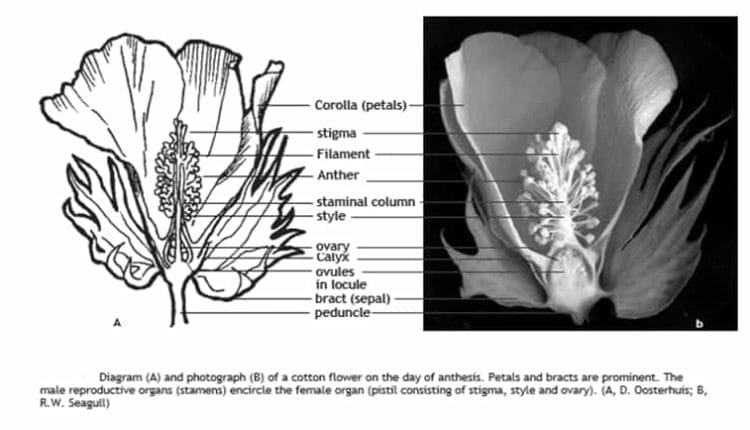
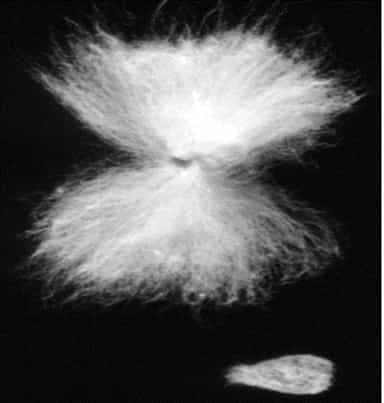
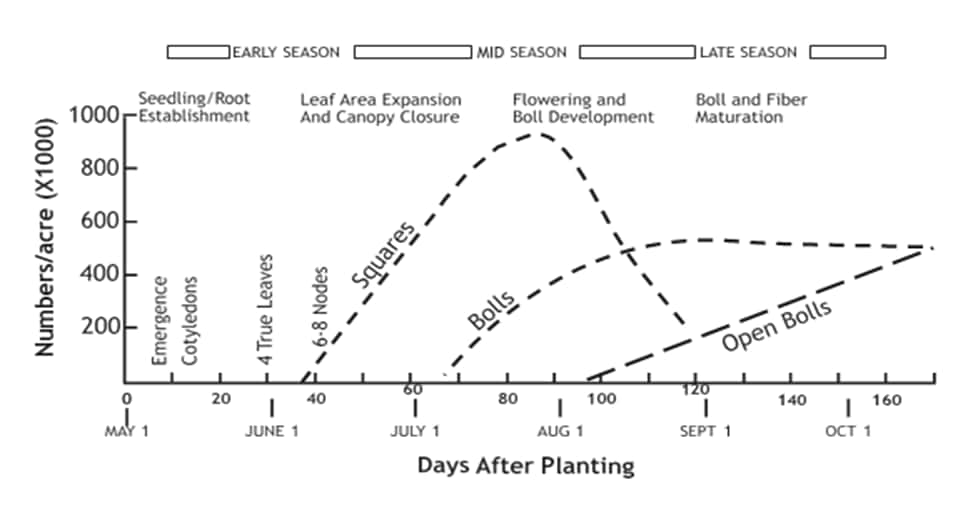
Cotton is a perennial shrub grown as an annual crop. It flowers over weeks, low branches first, and each fertilised flower becomes a boll, a capsule of three to five compartments (locules), each holding several seeds. Every seed grows thousands of fibres. Each starts as a single cell of the seed’s surface that elongates for its first weeks, then thickens its wall with cellulose until the boll splits open and the fibres dry and collapse into ribbons.

Picking, stripping and modules
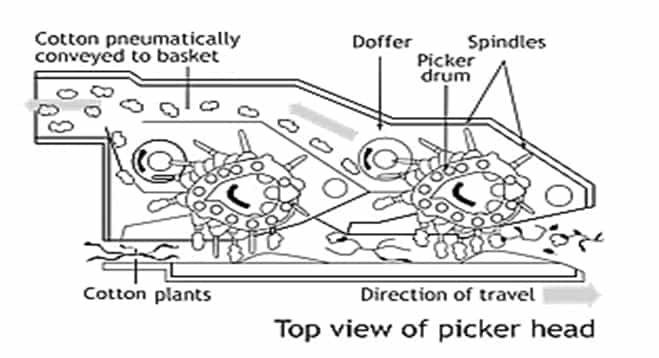
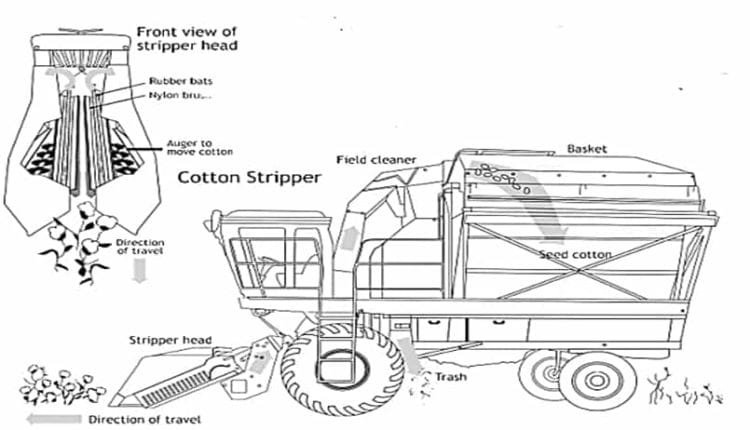
Harvested cotton, lint still on the seed, is seed cotton (kapas in India). Where it is picked by machine there are two kinds of harvester. A spindle picker pulls seed cotton from the open bolls with rotating barbed spindles and leaves the plant standing; a stripper pulls off whole bolls with brushes or bats, burrs and all, which means more trash to clean at the gin. Seed cotton is packed into modules in the field until the gin can take it. In some parts of the world cotton is still picked by hand.

Ginning: separating lint from seed
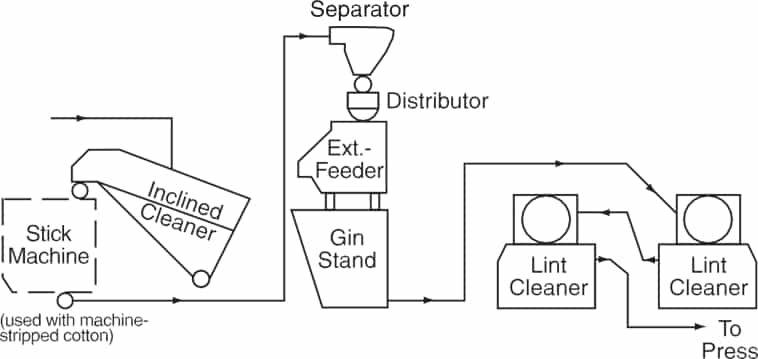
The gin dries and cleans the seed cotton, separates the fibre (lint) from the seed, cleans the lint again and presses it into bales. Two kinds of gin do the separating. The saw gin, which Eli Whitney built in 1793 and patented in 1794 (US National Archives), pulls lint through narrow ribs with toothed saws; the roller gin draws it off the seed between a roller and a blade. “Historically, upland cottons are saw ginned at high speeds, whereas ELS cottons have been roller ginned at low speeds to preserve fiber length and uniformity” (Delhom, Armijo and Hughs, Journal of Cotton Science, 2017). In India about 90% of cotton goes through double-roller gins; worldwide, saw gins handle about 55% and double-roller gins about 35% (Patil and Arude, ICAR-CIRCOT).
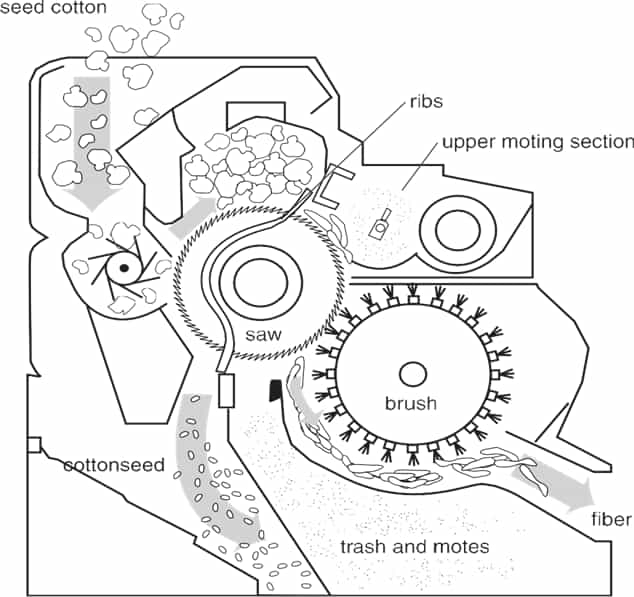
About a third of seed cotton by weight is lint: “Raw cottonseed comprises roughly one-third lint and two-thirds seed” (PIB). Measured gin turnouts in the 2017 study ran from 33.0 to 39.5%. The seed goes to oil mills and feed. Lint is pressed into bales: “Average net bale weight is 495 lbs. (for statistical purposes average bale weight is 480 lbs.)” in the US (Cotton Incorporated), while India counts in bales of 170 kg. Bale sizes are standardised in ISO 8115-1, and the bale net mass and bale press density calculators work with them. The site’s ginning pages go further.
From bale to yarn
At the mill, bales are laid down in a planned mix, opened and cleaned in the blow room, carded into a sliver, and for finer yarns combed to remove short fibre. The sliver is drawn, roved and spun on ring frames, or spun direct from sliver on rotor machines for coarser counts. The bale laydown calculator balances a mix by HVI values, and the blow room waste calculator prices the cleaning. Cotton yarns are numbered in the English count, Ne; the worked example above converts one.
Where cotton is grown, and what it costs
The US Department of Agriculture puts world production at 26.03 million tonnes in 2024/25 and 26.55 million in 2025/26, and forecasts 25.54 million for 2026/27, “as smaller crops in Pakistan, Turkey, and the United States more than offset larger crops in Brazil, Kazakhstan, and West Africa” (USDA FAS, Cotton: World Markets and Trade, September 2026).
| Country | Production 2025/26, million 480-lb bales |
|---|---|
| China | 35.80 |
| India | 23.80 |
| Brazil | 18.75 |
| United States | 13.90 |
| Pakistan | 5.30 |
| Australia | 4.50 |
| Uzbekistan | 3.45 |
| Turkey | 3.05 |
| World | 121.95 |
Growing and selling are different rankings. Brazil has out-exported the United States since 2023/24, when it shipped 12.31 million bales to the US’s 11.75 million; “The United States accounted for 27 percent of global cotton exports in 2025/26, down 1 percent from 2024/25 as Brazil exported record volumes for the third consecutive year” (USDA FAS).
The site follows the price three ways. The IMF’s world benchmark was 88.78 US cents a pound in July 2026 (world cotton). China’s domestic futures settled at 15,620 yuan a tonne on 30 September 2026 (Zhengzhou cotton), and cotton yarn at 21,845 (Zhengzhou cotton yarn); the gap between the two is roughly what spinning adds, which the spinning margin page tracks.
Cotton in India
“India ranks first in the world in cotton cultivation area (in hectares), with 114.84 lakh hectares devoted to the crop. This accounts for around 38 percent of the global cotton area of 304.08 lakh hectares” (PIB, July 2026). With 38% of the area it grew about a fifth of the world’s crop in 2025/26 (USDA), so its yields are lower than China’s or Brazil’s. Estimates differ by source, so name the one you quote: the government put the 2024-25 crop at 297.24 lakh bales of 170 kg (5.06 million tonnes) and 2025-26, provisionally, at 290.91 lakh bales (4.95 million tonnes); the Cotton Association of India’s estimate for 2025-26 is 339.00 lakh bales (CAI, August 2026); USDA’s 23.8 million 480-lb bales is about 305 lakh Indian bales.
- Support price. The minimum support price applies to seed cotton (kapas): ₹7,710 a quintal for medium staple and ₹8,110 for long staple in 2025-26, raised to ₹8,267 and ₹8,667 for 2026-27, with the Cotton Corporation of India buying when market prices fall below it (PIB).
- Bt cotton covers “more than 96%” of the area, according to a written reply in the Lok Sabha on 7 August 2024, as reported by Global Agriculture.
- Kasturi Cotton Bharat is the government’s brand for traceable, certified Indian cotton, run with the Cotton Corporation of India and TEXPROCIL, with an outlay of ₹30 crore (PIB).
- Organic. India grows most of the world’s organic cotton: 436,648 tonnes certified to the India Organic Regulation in 2023/24, out of about 706,000 tonnes worldwide (Textile Exchange), about 62% by this page’s arithmetic. The site’s organic cotton farming page covers the practice.
India’s mills test to the BIS methods, among them IS 1315 for the count of cotton-system yarns and IS 1671 for their strength.
Is cotton sustainable? Water, pesticides and organic cotton
Water. The global average water footprint of cotton lint is 9,113 cubic metres a tonne, of which 5,163 is rain (green), 2,955 irrigation (blue) and 996 the water needed to dilute pollution (grey); for seed cotton it is 4,029 (Mekonnen and Hoekstra, 2011). Rain-fed cotton and irrigated cotton in a dry basin are very different crops.
Pesticides. The figure usually quoted, 16% of the world’s insecticides on 2.5% of its farmland, is out of date. The ICAC’s figures for 2018 to 2022: cotton was “cultivated on 2.3% of the world’s arable land, accounted for only 4.0% of global pesticide use and 10.51% of total insecticides used in agriculture worldwide”, which it calls “significant, but… a more modest figure than the 16% often cited” (ICAC Recorder, June 2024).
Organic and certified cotton. Organic cotton was about 2.9% of the world’s cotton in 2023/24 (Textile Exchange), more than the “under 1%” often repeated. Sustainability programmes such as Better Cotton and OEKO-TEX Organic Cotton set their own rules. A fibre’s footprint is only its first stage: scouring, bleaching, dyeing and finishing add water, energy and chemicals, which the carbon footprint calculator adds up. The site’s articles on organic cotton production and innovations in cotton processing go further.
A short history of cotton
- The oldest find in the Old World is cotton thread preserved inside a copper bead from a burial of the 6th millennium BC at Mehrgarh, Pakistan, “the earliest known example of cotton in the Old World”, though not necessarily from a domesticated plant (Moulherat and colleagues, Journal of Archaeological Science, 2002).
- Mohenjo-daro yielded scraps of cotton cloth stuck to a silver vase, from “a plant closely related to Gossypium arboreum“; the excavator dated the city to about 3250 to 2750 BC (Marshall, Mohenjo-daro and the Indus Civilization, 1931).
- The Americas domesticated cotton separately: G. barbadense in South America about 8,000 years ago and G. hirsutum in Mesoamerica about 5,500 years ago (Viot and Wendel, 2023). Today’s Upland and Pima both descend from them.
- The gin and the mills. Whitney’s saw gin (1793) made short-staple Upland cotton cheap to clean; Mercer’s caustic treatment (1844), with Lowe’s tension added in 1889 and 1890, gave cotton lustre and strength.
Uses of cotton
- Clothing: T-shirts and knitwear, shirting, denim and other twills, underwear, socks. The types of fabric page lists the cotton cloths: calico, poplin, lawn, voile, denim, drill, canvas, terry and more.
- Home: sheets, towels, curtains, upholstery; the bed linen calculator works out the fabric for a sheet.
- Medical and hygiene: absorbent cotton wool, gauze and swabs, made to the pharmacopoeia standards above, and cotton nonwovens.
- Blends: polyester and cotton, the most common blend, and cotton with linen, viscose or elastane.

Related on this site
- Cotton ginning and ginning in textile manufacturing.
- Sampling from cotton bales, and cotton varieties for industrial use.
- Natural cellulosic seed fibres, and plant fibres.
- Looking after organic cotton clothes.
- The list of textile fibres, and fibres under the microscope.
Sources and corrections
Every figure on this page was read at its source on 6 October 2026. Where sources disagree, both values are given, with the source named.
- Definitions: Regulation (EU) No 1007/2011, Annex I, and its consolidated text, Annex IX; US 16 CFR Part 303.
- Fibre, structure and properties: Cotton Incorporated, Cotton Fiber Tech Guide: morphology and chemistry, properties and preparation, and the US cotton fiber chart; C. E. Grover and colleagues, BMC Genomics, 2025; C. H. Haigler and colleagues, Frontiers in Plant Science 3, 2012 and Plant Physiology 95, 1991; Canadian Conservation Institute, CCI Notes 13/11; Bureau of Indian Standards, IS 13157:1991; European Pharmacopoeia, monograph 0036, absorbent cotton; Woolmark, Wool is fire resistant (cotton’s ignition and LOI, citing CSIRO); Textile Research Centre, Leiden, mercerisation.
- Grading and species: USDA Agricultural Marketing Service, The Classification of Cotton, Agricultural Handbook 566, Cotton Incorporated edition, 2018; ICAC, Specialty Cotton Report 2025; R. Owen, Proceedings of the British Academy 96, 1999.
- Ginning: US National Archives, Eli Whitney’s patent for the cotton gin; C. D. Delhom, C. B. Armijo and S. E. Hughs, Journal of Cotton Science 21, 2017; P. G. Patil and V. G. Arude, ICAR-CIRCOT, Recent advances in cotton ginning technology in India.
- Production, trade and India: USDA Foreign Agricultural Service, Cotton: World Markets and Trade, September 2026; Textile Exchange, Materials Market Report 2025; Press Information Bureau, White Gold: India’s Cotton Story, 20 July 2026; Cotton Association of India, monthly report, August 2026; IMF primary commodity prices via FRED, PCOTTINDUSDM; Zhengzhou Commodity Exchange settlements.
- Environment and care: M. M. Mekonnen and A. Y. Hoekstra, Hydrology and Earth System Sciences 15, 2011; ICAC, ICAC Recorder, June 2024; GINETEX, care symbols; M. F. Potter, Clothes moths, University of Kentucky.
- History: S. Moulherat and colleagues, Journal of Archaeological Science 29, 2002; J. Marshall, Mohenjo-daro and the Indus Civilization, 1931; C. R. Viot and J. F. Wendel, Critical Reviews in Plant Sciences, 2023.
Change log. 6 October 2026: rewritten in full, with the site’s other overview of cotton fibre and its properties folded in. Corrected from the earlier versions: cotton has been used for at least 7,000 years, not “over 1000”; clothes moths do not eat it unless it is blended with wool or soiled; it is not “a good conductor of electricity”; Upland is about 95% of world production; a US statistical bale is 480 lb, with real bales averaging 495, not “500 pounds”; the wet strength gain is about 10 to 20%, where the earlier pages said 10% in one place and 20 to 25% in another; and organic cotton is about 2.9% of the crop. Removed: market shares from 2004 and production figures with no year, a description of an “artificial cotton” made from bark copied from a patent abstract, a list of fabric types that included wool, and the “27 times its weight” absorbency claim.
Found an error? Please tell us through the contact page, naming the section and the source that disagrees.


Sorry, I saw a typo in my email address in prior comment.
It is corrected here.
This is truly an amazing write-up you have here. I must confess that I was impressed by the first few paragraphs. This goes without saying you make an amazing blogger and your information is right on point. If you are ever interested in guest posting, you can check out my site at
death runandfootball starshttps://www.cinegists .com/cookie-run-kingdom-tier-list-and-how-to-downloadGreat content.
Well detailed, explanatory and informative. Thanks for the useful tip. You can also check this:
Fiber typesYour article is nice and I really want to thank you for
sharingthis post as it contains a lot ofdetails, keep up this good work.Great post, thank you for sharing it was helpful.
I love this update, thank you for always proferring solutions on your blog. see these sites for amazing content.
Never knew this was on the internet, this was really
helpfuland it was nice reading it. I will be glad to share it with others.Cotton fibers develop in a boll across the cotton seeds. Those bolls want to be harvested through a spindle picker or it’s far first-class to handpick them. The use of cotton for cloth is an idea up to now to prehistoric times; fragments of cotton material dated to the 5th millennium BC were placed withinside the Indus Valley Civilization, in addition to material remnants dated decrease returned to 6000 BC in Peru. Although cultivated because of the reality that antiquity, Cotton fibers grow around the cottonseed. And it is 100% cotton fibers the size of the cotton fiber can be from 0.5 to 2.0 inches. “4” types of
cotton fibers– Upland Cotton, Pima & Egyptian cotton, tree cotton, Levant cotton…. Aanya linens make bedding products using these types of cotton, allowing them to make the best quality products.If seen in the 21st century, the use of cotton is increasing very fast however if seen, cotton is a great fabric widely used. There are users of clothes made from cotton fibers all over the world. Cotton fibers are used not only in the form of clothes. So in the field of medicine too many things started being done, Cotton fibers grow around the cottonseed. And it is 100%
cotton fibersthe size of the cotton fiber can be from 0.5 to 2.0 inches. “4” types of Cotton fibers – Upland Cotton, Pima & Egyptian cotton, tree cotton, Levant cotton… Aanya linens make bedding products using these types of cotton, allowing them to make the best quality products.
How might strength or flexibility be altered if you changed the time when cellulose was added?
hello, can you give me information about 100% cotton muslin fabric shrinkage rate. Thanks
hey I have a question and i was hoping you could help. I work with patients in wound care and lymphedema. I use “Comprilan” and “Rosidal k” a lot for my patients. These bandages advertise 100% cotton but seem to have incredible elastomeric properties What material allows this elasticity? How can this be 100% cotton.??????
As such cotton does have high elasticity not more than 10%. If the fabric is getting stretched more than that but around 20% it can with modified fabric and yarn construction like higher twist in yarn. If suppose elasticity is further more, then it can be other fibre like Nylon (one man made fibre). In case of cotton fabric elasticity is enhanced around 30 to 200% with the addition of Lycra filament (ranging 4-10% by weight) during fabric or yarn manufacturing. This you can see in socks, elastic knitted fabric and cotton stretchable elastic jeans. In that case it is specificaly mentioned Lycra % on fabric garment. In such fabric if you open yarn from fabric you will find very tinny white filament i.e Lycra filament (like synthetic rubber- 3-4 time elasticity).
You can check if it 100% cotton or not by burn test