The term Man-Made Mineral Fibres (MMMF) is the generic name for a wide variety of manufactured fibrous materials. It is of a woolly consistency normally made of molten glass, rock or slag. Individually they may be known as glass wool, rock wool or slag wool according to the materials from which they are manufactured. The term does not include naturally occurring silicate fibers such as asbestos. It also does not include Man-made organic fibers such as nylon and rayon.
There is a wide variety of MMMF available. Man-made mineral fiber is widely used:
- as thermal and acoustic insulation in buildings and process plant
- for structural fire protection
- for pipe insulation
- for high-efficiency filtration
- generally, as a replacement for asbestos, use of which is now banned
MMMF is commonly used in insulation boards, blankets for the purpose of heat treatment, as electrical insulation and in the reinforcement of plastic and cement.
Commonly used Man-Made Mineral Fiber (MMMF)
Some of the commonly used ManMade Mineral Fibers (MMMF) are:
Glass Fiber
 Glass fiber is produced by a variety of techniques, which depend on the final product required (for example solid, mat or rope). For instance, it can be made into a mineral wool mat and used for insulation purposes, (loft insulation, soundproofing, etc.). The mineral wool mat may also be increased in density and stiffened to produce a pre-formed rigid section to be used as pipe insulation.
The glass fiber produced has an average diameter of around 4 to 9 µm, which is in the respirable range (capable of being breathed in). The fiber mat may also contain spherical particles of glass. These spherical particles are typically 100 µm in diameter.
Rock wool
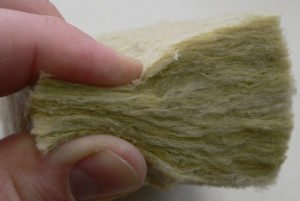 Rock wool is made by melting a mixture of metallurgical and chemical slag with basaltic rock using similar techniques to those used in producing glass fiber. The rock wool produced is used as a thermal insulation and as a sound absorbent material. It is also highly resistant to temperatures up to about 600º C and is not affected by water. It is used as thermal insulation in an industrial plant, pipes, and boilers etc. and in construction for insulating walls and roof spaces. Rock wool is also widely used as an acoustic absorbent material for television, radio and drama studios.
Ceramic Fiber
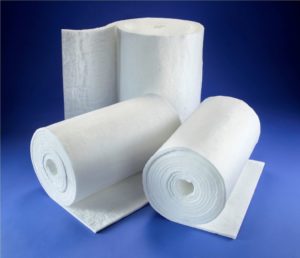 Ceramic Fibres are made from the same alumino-silicate group of materials which are used in the ceramic industries and are also known as ‘Alumino-Silicate Ceramic Fibres’ and ‘Refractory Fibres’.
Ceramic fibers have been manufactured and used worldwide since 1940’s. They are produced at 2000º C and the manufactured material is also able to withstand temperatures up to 1260º C to 1400º C. The material is also resistant to water and most chemicals and used to produce high-temperature refractory linings, thermal insulation blankets, felts, ropes, gaskets, and papers.
Types of Man-Made Mineral Fibers
| Type | Name | Some Uses |
|---|---|---|
| Glass | Fibreglass | Reinforced plastics and cements |
| Glass Wool | Heat resistant textiles | |
| Glass Roving | Insulation | |
| cont Filament | ||
| Mineral wools | Rock Wool | Thermal Insulation |
| Slag Wool | ||
| Ceramic Fibers | Safil | High-Temperature Insulation |
| Fibrefrax | -Power Stations | |
| Triton | Furnace Lining | |
| Refrasil | Gas Turbines | |
| Zircar | ||
| Cerachem | ||
| Refractory fibers | Boron Nitride/Carbide | Limited specialist use |
| Silicon Nitride/Carbide | ||
| Special Purpose superfine fibers | Refrasil | Manufacture of special papers eg. filter papers |
| Microquartz | ||
| Min-K |