

Introduction
Throughout the long history of the tinctorial arts, the dyer has been confronted with match the performance of has colourants as closely as possible with the useful life of the fabric.
The dyeing of cotton (cellulosic) with direct, vat or azoic dyes depends on adsorption of dye molecules into the fibre, while vat and azoic dyes, the dyes are first adsorbed on to the fibre followed by reaction to convert them into an insoluble form, thus retained on the fibre. The possibility of attaching dyes to fibres by forming covalent bond has for long been attractive to dyestuff chemists because attachment by physical adsorption and mechanical retention has the disadvantages of either low wet fastness or high cost1.
An event which had far-reaching consequences was the discovery made by Rattee and Stephen (ICI) in 1954, of dyes containing a dichlorotriazinyl group which could be applied from aqueous solution and caused to form a covalent bond with cellulose by increasing the pH. This discovery resulted in first commercial reactive dyes for cellulose.
The appearance of reactive dyes on the market gave a great impulse to the investigation of reactive systems other the s-triazine and within a few years, several other ranges of commercial reactive dyes were available. The impact of reactive dyes in the synthetic dyestuffs scenario has been to such an extent that today reactive dyes constitute the largest group of dyes both on a monetary and bulk basis.
The reason for such rapid increases in demand for reactive dyes is primarily due to the excellent characteristic of reactive dyes. Eg. Their brilliant shades, excellent wet fastness of dying and simple dyeing operations, which have increasingly been accepted within the industry.
Despite the obvious advantage associated with reactive dyes, there are many problems with present qualified by reactive dyes have been raised below:
- In exhaust dye the degree of exhaustion and fixation is low and the colouring
- The degree of wastewater is high.
- The problem occurs in levelness and reproducibility of dying.
- More water, energy and a long time are required for washing off.
- In wearing or washing textile goods of reactive dye or printing, colour change and bleeding to white areas can be done which leads to consumer complaints that for such problem many companies have developed the dyes for dyeing theories.
During the last decade, polyester-cotton blends have emerged as the single largest fabric used. In order to dye polyester-cotton blends, it is necessary to use disperse dye to colour the polyester together with a suitable dye for the cotton component, and it is obviously economical to apply both dyes simultaneously in a single process rather than using them separately.
In the single dyeing process the application temperature is fixed by the need to apply the disperse dye at an elevated temperature, and when the chosen cotton dye is a reactive dye this limits the choice to those dyes designed for the host application. An immediate difficulty arises because the satisfactory applications of disperse dye calls for the dyeing process to be operated either at neutrality or under acidic condition. Since alkaline condition lower dispersion stability, whereas the pressure of alkali is normally required for the application of reactive dye in order to ionize the cellulose and promote the dye-fibre reaction. Many developments have been done in this aspect during the last few years.
The research activity in reactive dyes has been mainly directed towards solving the mentioned deficiencies of reactive dyes. Moreover, the use of some new chromophoric system has been disclosed in the patent literature.
Chemistry of Reactive Dyes
The dyeing principle based on the fibre reactivity involves the reaction of a functional group of the dyestuff with a site on the fibre to form a covalent link between the dye molecules and the substrate.2
The four structural feature of a typical reactive dyes molecule are:
- The chromophoric grouping, contributing the colour much of the substantively for cellulose.
- The reactive system, enabling them to dye to react with the hydroxyl group in cellulose.
- A bridging group that links the reactive system to the chromophore
- One or more solubilising group, usually sulphuric acid substituent attached to the chromophoric group for their colour, although the azo chromophore –N=N- is by far the most important
All reactive dye contain sodium sulphonate group for solubility and dissolve in water to give coloured sulphonate anions and sodium cations. Most reactive dyes have from one to four of these sulphonate group-reactive dye molecules. However, do have several specific structural features of their own.
The general form of the reactive dye is as follows.
S——R——B—-X
Where,
- S = Water solubility group
- R = Chromophore
- X = Reactive system
- B = Bond between reactive system and Chromophore
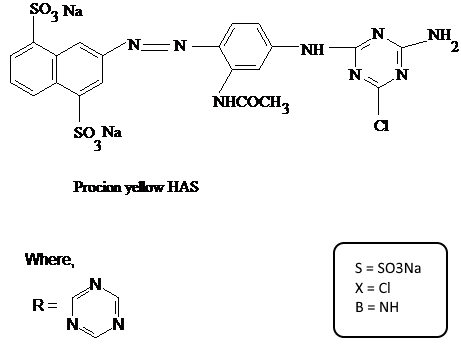 Chromophore (R): It is the colour producing part. The Chromophore absorbs a certain wavelength of incident white light and reflects the rest, which incident on the eye retina giving colour vision.
Reactive system (X): Reactive system reacts with fibres forming XF dye covalent bond. It influences the fastness property.
Bridging group (B): Bridging group links R and X which determines stability and reactivity of the dye particle. In some, the reactive group is directly attached to the Chromophore and most reactive system contains a heterocyclic ring that contributes some substantivity for cellulose. The sulphatoethyl sulphone precursor of the vinyl sulphone reactive group contributes significantly to the aqueous solubility of reactive dyes.
Water solubility: This group imparts water to dye. Generally, it is sodium salt of sulphuric acid. One should always keep in mind that the easier is the application of the dye on the fibres the easier is the removal from fibres.
Classification of Reactive Dyes
Monofunctional Type
The most important reactive system contains an only possible reactive centre, such as the halogen substituent in the aminohalotriaz the dye or the activated terminal carbon atom in vinylsulphone system.3
In the other two equivalent replaceable halogen substituent dichlorotriazine, diflouropyrimidine hetrocyclic ring system. The reactivity of the remaining halogen substituent is greatly decreased by the presence of the new hydroxyl or cellulose substituent.
The different monofunctional reactive dyes are as follows.
| No. | REACTIVE DYE | BRAND | NAME |
|---|---|---|---|
| 1 | Dichlorotrazine dye | Procion MX | Zeneca |
| 2 | Aminochlorotriazine dye | Procion H | Zeneca |
| 3 | Aminoflurotriazine dye | Cibacion | CGY |
| 4 | Trichloropyridine dye | Drimarine X | S |
| 5 | Dichloroquinoxaline dye | Levafix | BAY |
| 6 | Sulphatoethyl-sulphone dye | Ramazol | HDE |
Bifunctional Type
It is a high value of Cuprammonium fluidity observed for dyeing of many reactive dyes full depths, although tests of tensile strength demonstrated that the cellulose remained undamaged. Investigation showed that these anomalous results were associated with those dye capable of forming cross-links between neighbouring cellulose chains.3
The degree of cross-linking was relatively insignificant for the typical pad-batch dyeing at ambient temperature, but thermal fixation by pad-dry steam method resulted in a much higher proportion of cross-linked dye molecules.
The different bifunctional dyes are as follows.
| No | REACTIVE DYE | BRAND | NAME |
|---|---|---|---|
| 1 | Bis(aminochlorotriazine) | Procion HE | Zeneca |
| 2 | Bis(aminonicotionotriazine) | Kayaceton react | KYK |
| 3 | Aminichlorotriazine-
Sulphatoethyl-sulphone |
Sumifix supra | NSK |
| 4 | Aminiflurotrizine-
Sulphatoethyl-sulphone |
Cebracin C | CGY |
Development in Reactive Dyes
Need for Development
The earlier reactive dyes contained dichlorotriazine and vinyl sulphone groups. These and other dyes were synthesized based on,
- There low affinity for textile especially cellulose fibres.
- On their reactivity towards fibres.
- The pH of the fixation reaction of the dye with the fibres.
- The optimum temperature of the reaction.
- Ease of washing out the hydrolyzed reactive dye from the dyed fibres.
Recently, three more parameters have been added the carcinogenicity of the dye, their reduction products, the sensitizing or the allergenic potential (causing constant dermatitis) and ease of treatment of the effluent containing these dyes, in view of the awareness of the requirement of the producing and offering to the end-user-Eco-friendly textile.
The reaction of these dyes with the functional group of the fibres like primarily hydroxyl group of cellulose and amino group of protein fibres is brought about by an alkali, such as sodium carbonate, sodium hydroxide, sodium silicates etc.
The dyeing of these dyes on the cellulosic fibre materials involves three distinct steps: 3
- Exhaustion of the dye in a neutral medium by the addition of common salt of the Glauber’s salt at a temperature lower than 1000
- Fixation if the exhausted dye by the addition of alkali, leading to the formation of a covalent bond between the dye and the fibre.
- Through washing out of the hydrolyzed reactive dye, which is loosely held on and in the fabric.
The third step is necessitated by the fact that, whereas a large portion of the reactive dye, taken for dyeing reacts with the fibre, some portion of dye does react with the water in the dye-bath under alkaline condition losing its reactivity toward the fibre and poor affinity for the fibre. If the step is not carried out properly, the washing fastness of the final dyeing becomes poor due to the presence of the hydrolyzed dye on fabric. While the dye reacted with the fibre contributes to the high washing fastness.
When a substantial amount of the dye is hydrolyzed during dyeing and washed out from the dyed fabric subsequently, it pollutes the dye-house effluent, leading to difficulties in the effluent treatment. Hence, high exhaustion reactive dyes have been made, so that very little amount of the dye gets hydrolyzed, leading to a less affluent problem.
Theoretically, it would be possible to achieve the objective of high fixation by use of dyes containing groups capable of reacting with cellulose without substantial hydrolysis. The problem has already been studied in case of reactive dyes for wool, where dyes containing acryloylamino groups (-CH2-CH-CO-NH2) suffer very little if any hydrolysis in a dye bath. Unfortunately, such groups although satisfactory in wool dyes are insufficiently active to provide the degree of reactivity usually considered desirable in reactive cellulose dyes.
The other possibility is to used dyes containing more than one reactive system the principle on which high fixation of dyes containing more than one reactive group is based is easily understood when dyeing process is regarded as acylation of alcohol that is cellulose conducted in water. A dye molecule with only one reactive centre that is a mono-functional acylation agent may react either with alcohol (cellulose) or with water, its reactivity is completely lost and it is in then incapable of reacting with former.
In the instance of a dye having more than one reactive centre, corresponding to a polyfunctional acylation agent, that part of a dye, which has reacted with water, is still capable of further reaction with cellulose is still capable of fixation on fibre.
Chemistry of New Reactive Dyes
Reactive dyes most commonly used for dyeing tend to fall into one of the two broad categories.
- Medium: High substantively dyes often described as salt-controlled reactive dyes, which exhibit a slow (poor) washing-off characteristic and whose level dyeing characteristics have to be controlled during electrolyte addition stage that is by portion-wise addition of salt.
- Low substantively dyes, often described as alkali: Controllable reactive dyes, which exhibit rapid (easy) washing–off properties and whose level dyeing properties have to be regulated by slow (progressive) addition of alkali. This is done in order to substrate during alkali addition, so as to prevent the phenomena of simultaneous exhaustion and fixation.
Types of New Reactive Dyes
Dichloro-Triazinyl (DCT) Type:
The reactivity of these dye towards cellulose is so high that react with cellulose at room temperature or in the cold under alkaline condition and hence they are called cold brand or M-brand reactive dyes. They are generally recommended for dying than for printing.1
Monochloro-S Triazinyl (MCT) Type:
These dyes have low reactivity towards cellulose and require more severe conditions like higher temperature, 800C, and higher alkalinity of fixation. They are readily soluble in water at 80-850C. they are suitable for dyeing and printing on cellulose fibre materials and are called Hot brand or H-brand reactive dyes.4
These dyes are less reactive than cold brand reactive dye. H-brand is more stable for storage. However, they are to be buffered to slightly acidic pH to protect them from getting hydrolysed under alkaline condition.
Like M-brand dye, H-brand dye too gets hydrolysed under an alkaline condition for fixation and they too need through soaping after dyeing to remove most of the hydrolysed dye in order to ensure the optimum wash fastness of the dyeing lead to the polluting the dye house effluent with a considerable amount of hydrolysed dye.
Vinyl Sulphone (VS) Type
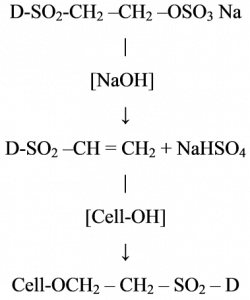
These are sulphoethyl sulphone dye in which form they are very stable in the absence of alkali and are buffered to slightly acidic pH 4
Under the alkaline condition, sulphoethyl sulphone group which otherwise has no reactivity towards cellulose is covalent into vinyl sulphone group, which is the actual reactive group, reacts with the hydroxy group of cellulose forming another group connecting the dye and the cellulose. Here too a covalent bond is formed between two: 5
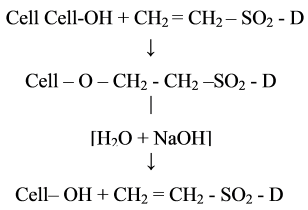
In this case, too, the vinyl sulphone form of the dye reacts with water under an alkaline condition in addition to the reaction with the cellulosic fibres. After dyeing the fibres with VS dyes, the hydrolysed dye which has no reactivity with and low affinity for cellulose fibres has to be removed from the dying by thoroughly soaping to get the optimum wash fastness. However, during soaping, a neutral non-ionic has to be used without any alkali. If the alkali is present in the soaping bath some amount of the dye, reactively dyed with the fibres come out in the soaping bath by the rupture of the covalent bond formed between the dye and the fiber, in case the VS reactive form of the dye is stripped, this may be lead to lightening of the shade extent in dying. 5
Homofunctional Type (He Brand): – (2MCT)
These dyes containing two triazinyl groups each containing one reactive chloro group are characterized by low affinities like M-brand and high exhaustion and fixation hence good build-up, washing-off of the dyed good is dye to be removed. This lead to less effluent problem since there are monochloro-s-triazine group, which are stability is good.
This dye is that even if one of the reactive chloro group reacts with water and gets hydrolysed during under alkali condition, there is still another reactive chloro group available in the dyestuff molecules for reaction with cellulose hence the higher shade build-up on the fibres, leaving less hydrolysed dye. Where both the reactive chloro groups react with water in the dye bath at the end of dyeing cross-linking of cellulose may take place.4
Hetro-Bifunctional Type (MCT+VS)
These dyes with bath chloro-triazine and sulphatoethyl sulphone groups in some dye molecules offer high all round fastness properties including perspiration, light and chlorine. These dyes have a high degree of exhaustion and fixation rates, better alkali stability and excellent levelling properties. Reproducible shades can be produced because of low sensitivity to temperature variation and to alkalinity.
These dyes have excellent storage stability. A very little amount of the dye gets hydrolysed and hence less washing off and effluent problem.
The dye-fibres bond of VS type part is stable to acid hydrolysis and hence the dyed good have good stability to the industrial acidic atmosphere due to nitrogen oxide and sulphur dioxides4
Polyfunctional Dyes
It should theoretically be possible to attain even greater fixation efficiency by incorporating addition-reactive group into the dye molecule. In practice, this approach can be counterproductive owing to the detrimental effect that additional groups can have on migration, leading to lower fixation, especially at heavier depths, and poor build-up. However several patent application relating to reactive dyes with three reactive groups have appeared. Also, some commercially successful dyes of this type are now available like CIBACRON Red C-2G and Remazol Red BS. In the case of trifunctional dyes possessing only one chromophore unit, the molecular weight contribution of the uncoloured reactive groups can be comparable to that of a chromophore.
Although the incorporation of three dissimilar reactive groups into a dye containing a single chromophore unit is clearly a less economic approach, the additional cont can sometimes be justified by exceptional technical properties.6
Neutral and Acid Fixing Reactive Dyes:
The increase in consumption of polyester cotton blend and the difficulties encountered in their colour ratio has been mentioned earlier. It is in this context that neutral and acid fixing reactive dye again significance.7
Neutral fixing reactive dyes:
These dyes react with cellulose by high-temperature neutral exhaustion dyeing making addition necessary. The actual dye residue ultimately bound to the fibres is the same as the based on monochloro-s-trizinly dye. For acceptable commercial use of quaternised triazine dyes it is important to ensure that the small of mines or salt does not cause a problem during either syntheses or application, moreover, the amines should be environmentally acceptable and nontoxic.
The dye fixation can be achieved in a neutral pH dye with quaternised based is quite straight forward. When the dye bath pH has raised the ionization of cellulose increases thus increasing the change of reaction with cellulose. In neutral pH, this does not occur. However, the cationic nature of the quaternised group contributes to the attraction between cellulose anion and dye. The employment of higher temperature also increases the concentration of cellulose anion. The problem of diffusion due to large molecule size can be completely avoided by adjusting the pH to a lower value than used for ordinary reactive dyes and by dying at a higher temperature. The result will be an improvement in the penetration into the interior of the fibre and level dyeing will be obtained. Thus dyes are useful for polyester cotton blends in conjunction with a disperse dye. 8
Acid fixing reactive dyes:
These are two acid fixing groups as shown in the below.
Dyes containing phosphoric acid groups:
The procion T dyes a range of liquid reactive dyes based on the phosphoric acid reactive group. Fixation of these takes place under acidic dyeing condition in the presence of carbodiimide at about 2000C.
Procion T dyes do not hydrolyze and of the end of the dyeing process retain the capacity for fixation. The disappointing fixation achieved under even the best condition recommended is through to be due to unfavourable competition from the carbodiimide side reaction.
High fixation value can be obtained by using solvents and cyanamide at 1600C. Steam fixation of phosphoric acid dye can be fixed on to cotton by steaming after padding and drying. Although some dye fixation is achieved by prolonged steaming at around 1200C, however, the fixation attained is too low to be of any significance, the dye fixation efficiency is very much greater which dicyandiamide is used and steaming done at 1800C.
Dyes containing carboxylic acid group:
Mono chlorotriazine dyes are condensed with amino group-containing molecule having a carboxylic group.
Although the dyeing system has all the advantages of acid fixing reactive dyes, the high concentration of cyanamide required as a co-reactant and the susceptibility of the ester cross-linkages, which bond the dye to the fabric, to hydrolysis during alkaline laundering are significant drawbacks.
Acid and neutral fixing reactive dyes are important for polyester-cotton blends and hence their consumption will increase which will lead to the synthesis of dyes having god properties and which react under these conditions.
New Reactive System 9
- Some novel azo reactive dyes containing an aldehyde group have been synthesized and the act as reactive dyes wool. They have excellent colour strength and very economical. 10
- New reactive dyes having good affinity for the fibre are obtained by introducing fluorine atom into the Vinyl sulphone group of conventional reactive dyes. This new reactive centre for dyes which form a covalent link with the fibre is SO3 CF = CFCl group.11 The dyes derived using this reactive system colour polyamide from an alkaline dye bath with the formation of a covalent linkage.
- A series of halo acetyl reactive dyes have been synthesized using halo acetyl groups. The reactivity of halo acetyl groups and their dyeing properties were studied. The results show that the bromoacetyl group is more reactive than the chloroacetyl group and molecules containing a bromoacetyl group would dye silk under relatively mild dyeing condition.12 Both the exhaustion and fixation on silk fabric are increased if a second reactive group is present in the molecule.
Properties of New Reactive Dyes
Sumifix supra dyes, marketed by Sumitomo of Japan, are heterobifunctional reactive dyes having a vinyl sulphone and monochlorotriazine group. These dyes are known for their high degree of exhaustion and fixation, good reproducibility and levelling properties.13 These are also temperature insensitive between 500C to 600C. The dyes are distinguished by medium substantivity in primary exhaustion phase and a high degree of exhaustion and fixation after addition of alkali.
Kayacelan reacts dyes introduced by Nippon Kayaku of Japan,14 reactive with cellulose at 1300C at neutral pH. This has made the most suitable for one-bath, one-stage dyeing if PET/cotton blends. The leaving group in the best knows for the reduction in processing time, simplified dyeing processed and increased productivity.
Procilene N dyes introduced by ICI, are the combination of dispersal PC disperse dyes and Procion T reactive dyes for the one-stage printing of cellulose/PET blend. Procion N range is a combination of the matched shades from dispersal PC dyes and elected Procion T monochlorotriazinyl reactive dyes. These dyes are fixed to the Polyester/cellulose blend under an approximately neutral condition.
Procion HEXL15 dyes, introduced by ICI, are basically molecularly refined dyes of Procion HE type. These are known for better technical performance and characterized by their excellent levelness and shade reproduction ability.
Bayer’s recently introduced a number of new products to its “Levafix” range of reactive a number of new products to its Levafix range of reactive dyes. Levafix royal blue E-fr is brilliant yellow, a turquoise and brilliant green dyes to its Levafix K 16 range. The fixation properties of these three dyes are nearly identical, which ensure reproducible combination dyeing.
Application Method of Reactive Dyes
Reactive dyes are known for their versatility in application technique on to the cotton substrates. Depending upon the reactive system, the application method varies.
Broadly, the application of the reactive dyes is classified into:
- Batch wise method
- Semi-continuous method
- Continuous method
This gives flexibility to a dyer in the production and programming and choice of an alternate method, which the situation demands.
Exhaust Method
The object of exhaust dyeing is to achieve level dyeing and reproducibility in practical dyeing times with maximum colour yield. The most common method in exhaust dyeing is to apply the first under the condition of no reaction by simplex exhaust procedure similar to that used for direct dyes and then to add alkali to allow the dye to react after most of the dyes are exhausted. At the completion of dyeing the fibres is removed by soaping achieve dyeing that is fast to wet treatments.17
This method may be done on jigger or winch. It comprises of two stages:
Exhaustion: During this stage, the dye is exhausted from the dye-bath and comes into the fibre phase. The material is run in a bath of water, dye and salt, both dye and Glauber’s salt are added into two parts. The condition for dying and fixation for the cold and hot brand that reacts through substitution mechanism is given in the table.
| Dye type | Temperature (0C) | Glauber’s salt (g/l) | Soda ash (g/l) | Time (min) |
|---|---|---|---|---|
| Cold brand | 30 | 25 to 90 | 2 to 15 | 45 to 60 |
| Hot brand | 80 to 85 | 30 to 90 | 10 to 20 | 60 to 90 |
| HE dyes | 80 to 90 | 30 to 100 | 30 to 50 | 60 to 90 |
Fixation: The fixation takes place in presence of alkali. After the addition of alkali, migration takes place either with the fibre or with the water molecules. The dyes present on the fibre preferentially react with the fibre.
The dyeing procedure for exhaust dyeing in Jigger is, Load the Jigger > Add dye in 2 ends > Run for in 2 ends > Add salt for 2 ends > Run for 2 ends > Add alkali in 2 ends > Run for 2 to 6 ends> Drain out the Jigger > Cold wash in 2 ends > Soaping in 2 ends > Hot washing in 2 ends > Cold washing in 2 ends.
Exhaust dyeing in Jigger using Remazol dyes.
In this method, the dye bath is heated to the recommended temperature. Then the dye solution and other additives are added in the bath in the following fashion.
- 1st End: Half the amount of dyestuff and half amount of salt.
- 2nd End: Remaining quantity of dyes stuff and salt.
- 3rd End: Half the amount of alkali.
- 4th End: Remaining quantity of alkali
Dyeing is then continued for 60 to 90 minutes depending upon the dyeing temperature. The processing data for jigger dyeing with Remazol of
Several temperatures are given in the table:
| TEMP(0C) | DYEING TIME (min) | GLAUBER’S SALT (g/l) | CAUSTIC SODA (cc/l) | SODA ASH (g/l) |
|---|---|---|---|---|
| 40 | 90 | — | 3 to 6 | 5 |
| 60 | 60 | 50 | 2 to 5 | 5 |
| 80 | 60 | 50 | — | 15 to 25 |
After the required time of batching the cloth is washed properly removed all unfixed dye.
Padding Methods
There are various padding methods.
Pad-batch method:
All pad-batch process is following a general sequence.
- Impregnation of the well prepared dry fabric as it of the dye and alkali at ambient temperature.
- Uniform squeezing of surplus liquor from the fabric as it passes through the magnet hip.
- Wrapping of the batch roll of wet fabric in Polythene film and storage at ambient temperature for specific well times.
It is a semi-continuous process and is an economical alternative to conventional exhaust method. The process is found to be very useful for medium batch size low water consumption and minimizing pollution. The process also ensures high reproducibility and the low cost of dying. 3
For dyeing by pad-batch method use of Na-silicate as alkali is giving popularity because of increased stability of dye bath and higher colour yield. Normally 100gpl (130tw) Na silicate with little caustic soda, 2gpl are added to the padding bath. The wet pickup of the fabric should be kept around 65.7 if it is more seepage of dye liquor take place. Addition of little Na alginate (40%paste) 5-10gpl help in minimizing the problem of seeping bath help easy removal of Na-silicate, the levelness of pad dyeing depends entirely on uniform dye liquor application.
In particular, it is not always easy to ensure this in the centre and the edge of food with padding of modern design. The pressure and the applied amount of dye liquor can be established across the width of the machine to compensate for a difference in the material itself by varying the pressure. Such a system also enables fabric of different with to be processed without problem. Expression and liquor add on can be continually monitored and corrected by means of modern humidity measuring in equipment.
Pad dry steam method:
In this dying system, a drying step is involved. The replace the exhaustion step in batch dyeing and consequently substantively is not needed to transport the dye to the fibre. The process is essentially same as that of the pad-batch method, but for this the addition of migration inhibitors Na-bicarbonate and wetting agent are added prior to padding the material is padded in cold, maintaining minimum pick up to reduce the tendency of migration and finally dried, in hot air stenter for 1-2 minute for fixation.
In the absence, if migration inhibitor in padding liquor the dye may migrate during dye result in level dyeing when the fabric is padded with the liquor the inter febrile arises, are swollen with liquor the dye dispersion can circulate freely through this capillary network. Install the average dyestuff particles size. During the dying, all the capillaries decrease in size as water is evaporated from fabric eventually the largest capillary diameter shrink to the size of the smallest dyestuff particles.3
Pad-dry pad steam method:
This method can be used for continuous production and for longer yardage suitable equipment such as padding mangle and a dryer are synchronized with a pad steam unit and a soaper. The cellulosic material to be dyed by this method must be highly absorbent free from finishing and sizing agent. The padding method is the same as in former use. The padded goods after drying are passed through a bath containing 250gpl caustic soda and the dyes are fixed by steaming for 20-30 second at 103-1050C.
Pad-dry cure method:
The machinery required for these methods is a good padding mangle with a small through. And a hot flue or flood dryer, which dries and fixes the dyestuff simultaneously. The dyestuff is dissolved with required quantity of water and the dissolved dyestuff solution is further diluted with cold water. Fixation does not take place under dry condition, so humectants are required. Urea about 5-100gpl is added to the cold solution for this purpose and other additives such as resist salt-o about 10gpl and soda ash about 10-30gpl are added to padding liquor 50-100pgl Na-alginate thickener may be used where fear of dyestuff migration is there. For fixation, the fabric is dried at 120-1400C for 4-2 minute.3
This process after several advantages over pad dry pad steam method such as:
- Lower machinery cost (pad dry range only)
- Less chemical
- Lesser energy (no steam)
- Easier wash off (no salt to remove)
- Better reproducibility (less strength to control)
After Treatment
Two factors are important during the after treatment of reactive dyeing. The dying should not be soaped of the boil under alkaline condition. This is ensured by neutralization with acetic acid before soaping. The hydrolysed dyes are the best removal buy boiling with a detergent solution at the boil. It is reduced at a higher temperature and at the boil the dye rapidly diffuse out. If this dye is removed completely it is not necessary to treat the dying with a cationic dye-fixing agent to achieve the optimum perspiration and water fastness.
When sodium silicate is used as the alkali for fixing the dye then neutralization with acetic acid should not be done. If in neutralized insoluble silica acid may get deposited in the fibres producing a harsh feel in this case, on overflow rinsing with warm water should be given before the boiling after treatment.
Development in the Dyeing Process
Trichromatic Dyeing by the Exhaust Process
Economic consideration, equality and ecologist and ecological arguments are the major factors about the ideal dyeing process and optimum dyestuff selection.
In the dying process, over 60% of reactive dyes are applied by the exhaust dyeing method. The remainders are applied by padding. The selection of the basic trichromatic system is of fundamental importance to dyers when they select their reactive dye range for the exhaust process. Combining a yellow, a red and a blue dye can dye a wide range of shades.18
Another major demand made for the trichromatic combination is good reproducibility, both when recipes are transferred from the laboratory to pilot or bulk. Condition and from one batch to another, even of dying here to be performed on different units and dyeing conditions cannot be dyeing be held constant.
To sum up, the main demands made in trichromatic reactive combination are reliable dyeing results, high cost-effectiveness, good reproducibility of shade even if dyeing condition vary, good levelness, good fastness properties flexible possibilities of application.
The new Remazol trichromatic system comprises:
- Remazol Yellow RR
- Remazol Red RR
- and Remazol Blue RR
These dyes are supplied as low dusting granules which are free-flowing and are suitable for use on automatic dosing units and for manual addition.
Remazol RR dyes have very good build-up on cotton and regenerated cellulosic only small dyes amount are needed to dye deep shades. The good build-up of these products makes them highly economical Remazol RR dyes can be used to dye a wide range of shades including a large number of trichromatic fashion shades. As well as being suitable for medium and deep shades, in many instances, Remazol RR dyes meet the requirements made on pale shades.
Homogeneous Exhaust Dyeing Behaviour
To achieve optimum reliability and reproducibility of dying, two main criteria have to be met.
- The best possible balance needs to be found between the properties of the trichromatic combinations, that is substantive, diffusion properties fixation behaviour and washing-off properties.
- Normal fluctuations in dyeing conditions should not affect reproducibility.
The hydrophilic sulpho groups in the masked reactive group and hydrophilic groups in the chromophore give the Remazol RR dyes excellent solubility. They can, therefore, apply also in ultra-short liquor ratio.
In standard dyeing condition in a neutral liquors ratio is like 2 % dye, 50gpl salt, liquor ratio 10:1, and at 600C. Remazol RR dyes have medium substantively. The dyes have very good diffusion properties in fibres. This ensures good penetration of the foods and thus level of dying, an equilibrium between substantively and diffusion is achieved very quickly so the neutral dyeing phase can be relatively short.
Since Remazol RR dyes are only moderately reactive, since the dyes have exhausted on to the fibres they have enough time to migrate into them, even in alkaline conditions before fixation occurs. Progressive dosing of alkali can be used to regulate the second exhaustion phase and fixation rate. It is not easy to give fixation data, which is, depends on the dyeing conditions. As a rule of thumb the lower the dyestuff concentration, the higher the salt load, the shorter the liquor ratio and the higher the affinity for the goods to be dyed the higher the fixation yield.
The relatively small amount of dyestuff required to dye specific shades and the comparatively high fixation yield is positive ecological attributes and help minimize the cost of wastewater treatment.
Dyeing Procedure
Progressive addition of the alkali has a significant impact on dying and allows optimum regulation of the exhaust process. This does not apply to vinyl sulphone dyes. The advantages of the automat system are now well known. Optimum fixation profile, excellent reproductively, excellent levelness, shortness dyeing times, automated dyeing process, fever rejects and fever operators required. The temperature of dying is adjusted at 600C. Following pretreatment of the goods, the salt and auxiliaries are pre-run in the bath and dyes are the entered into the liquor using a miner dosing system. After a short diffusion phase, the alkali dosing programmed can be started. This should be followed by a final fixation period.
By varying dyeing parameters such as the salt load, type and amount of alkali, addition profile and duration of individual steps in the dying process, the dyeing method can be adjusted to suit virtually all article qualities and depths of shades, including articles made of regenerated cellulosic fibers such as viscose, modal, polynosic, lyocell and cupra.
The fixation yield obtained with Remazol RR dyes is roughly the same when using both soda ash \ caustic soda solution and soda ash on its own. A combination is used in Europe because alkali costs are lower, the procedure is relatively simple and advanced dosing technology is available.
By contrast, most dye house in Asia still use traditional dyeing methods, that is soda ash is as used as the fixation alkali. In this region, the use of a caustic soda solution is frequently rejected on safety grounds because the alkali is added manually.
All this show that the Remazol RR trichromatic system is a convincing and cost-effective solution.
After Treatments
The high fixation yield of Remazol RR dyes means that only small amounts of hydrolysate need to be washed off. Since second exhaustion is generally over 90% most of the hydrolysate is removed with the dye liquor when it is drained out of the bath. The first after treatment bath serves two purposes: it reduces the salt concentration, then by reducing the substantivity of unfixed dyestuff, and washes off the alkali. In the second bath, the goods are acidified to prevent partial hydrolysis fixed dyes during the subsequent soaping stage.
The hot bath brings the unfixed dyes to the surface of the fibre so that they can be washed out and removed with the liquor when it is drained from the bath. Because of the low quality of hydrolysis and the good washing off properties of Remazol RR dyes, after treatment to obtain the required level of wet fastness can be performed quickly and requires relatively little energy and water.
Fastness Properties
With Remazol RR dyes, it is possible to obtain fastness properties that are the demands normally made on sports and leisure wear. Here two features of the fastness property outline.
- Lightfastness: Remazol RR dyes have unusual properties when exposed to light although the dying light fastness somewhat, the basic shade remains unchanged. This is an advantage for dyes and end user alike and means that the light fastness of pale shades is acceptable for most articles. For example, If Remazol Blue RR is replaced by Blue dye with high lightfastness such as Remazol Brilliance BB the dyeing exhibits of shade after exposure to light and is no better than the result obtained with the original dye.
- Stability to Acids: The dyestuff-fibre bond formed by Remazol RR dyes is extremely suitable to acids. So Remazol RR dyes are ideal for dyeing Polyester/Cellulose by the reverse dyeing process.
Low Salt Reactive Dyeing
A new range of reactive dyes for cotton based on the very well established bifunctional Sumifix Supra dyes from Sumitomo offers the two advantages of excellent exhaustion and fixation and is suitable for a low salt application. 19
With the increase of reactive used it has become necessary to counter the damage by reactive dyeing there is a large volume of coloured wastewater due to low exhaustion and fixation and high salt content is wastewater from large quantities of salt and alkali.
As well as environment pressure the production cost needs to be reduced where possible without compromising overall productivity.
The advantage of low salt dyeing includes:
- High productivity
- Low dyeing cost
- Good levelling
- Good migration
- Easy wash-off
The advantage of new dyes is that they show a very small variation in fixation and exhaustion at conventional and low salt application. All have similar for selecting product suitable for a low salt application.
The reduced quantities of salt required to enable the optimum method of addition of salt to be selected. When adding 50gpl salt, machine limitation often force pre-salting this can cause unleveled dyeing. In critical cases where liquid salt addition is necessary the lower quantities make it possible without altering both volumes greatly. Low salt addition saves time and assist level dyeing and result in less re-dyes.
Low salt dyeing is also easier to wash off in comparison to those dyeing carried out a conventional quantity of salt. This is because the washing off the property of reactive dyes is related to it’s substantive to cellulose the lower the substantively the easier. It is to remove the hydrolysed dyestuff easier washing off save time. Basically, a saving of salt between 30% and 50% is possible.
There are two methods that can be used for law salt dyeing.
Temperature Raise Method
This method gives higher dyeing affinity than adding the salt at a high temperature. This method produces the highest colour yield due to the gradual build-up with the increase in temperature.
Constant Temperature dyeing method
This method to decreased affinity at a high-temperature result improves the migration. This dyeing method is suitable for high-density fabric and yarn dyeing.
The range of Sumicix, EX-F and HE dyes, plus some other Sumfix Supra dyes suitable for low salt application is as follows.
Trichromatic
- Yellow component
- Red component
Blue component
- Yellow-brown ex-e gran
- Yellow 3re 15% b gran
- Rubine ex-e gran
- Red 4bnf 150% gran
- Blue ex-f gran
- Blue rnf gran
| SHADE | SUMIFIX | SUPERDYES |
|---|---|---|
| Scarlet |
|
|
| NAVY |
|
|
| BRILLIANT BLUE | SUMFIX BRILL BLUE GL CON GRAN |
Other ranges of low salt reactive dyes are as follows:
CIBACRON LS range
This range utilizes several different reactive groups in a number of different arrangements.20 the bulk is bifunctional, usually bis-monoflurotrizines 21,22. Other groups or combination of groups are also used, including monoflurotriazine and monochlorotriazine in combination with vinyl sulphone as well as a trifunctional dye.6
As is usual with batch wise dying of other reactive dyes, the CIBACRON dying is applied in the presence of an electrolyte, albeit reduced levels, typically for 30 min, followed by addition of alkali to effect fixation, generally over 60 min.
Remazol EF range
These dyes are essentially conventional vinyl sulphones. This particular reactive group is somewhat different from the halotriazine, which is generally less substantive than the reactive dye itself, and easily wash out after completion of dying. In this dyeing two ureido groups have been claimed by Dystar to fix and to build up well in the presence of a reduced concentration of the electrolyte.23 In this case, the ureido groups might be expected to contribute to increased substantively, leading to a lower salt requirement 6
No Salt Dyeing
Several approaches have been in vogue in practice to achieve optimum results:
- Use of high fixation reaction dyes
- Increasing the dye exhaustion
High fixation reactive dyes have several reactive groups and thus offers increased chances of dying of reactive dyes with dye-fibre bonding. However, for obtaining heavier shades it becomes extremely difficult to control the hydrolysis.
The fact that the fixation of reactive of reactive dyes on substrates containing amino groups is much higher than on cellulosic fibres has been responsible for initiating a large amount of work in introducing amino residues in cellulosic fibres.
Treating the cellulose with, for example, N-2-sulphatoethylpiperazine in a padding process, in the present of sodium hydroxide, and heating to 1500C for 2.5 min achieve this. The resulting modified cellulose, possessing many covalently bound piperazine units, was then reacted with conventional reactive dyes without any additional alkali. 24
Modification with glycidyl trimethylammonium chloride
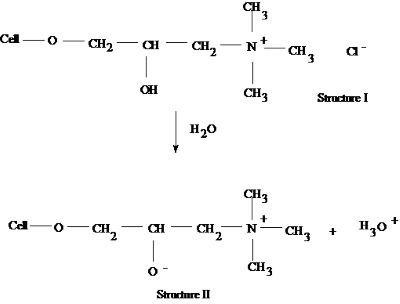 Glycidyl trimethylammonium chloride or its precursor 1-chloro-2-hydroxy-3-trimethylammonium propane was used to modify cellulose.
The modification has been recommended in a pad-bake or in an alkaline pad-batch process. Since the structure (II) is predominantly prevalent the anionic sulfonated reactive dye is initially absorbed on to the fibre by ionic attraction to the quarternary ammonium residue.25
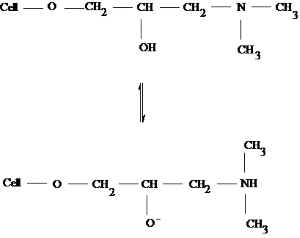
Modification with N, N-dymethylazetidinium chloride (DMMAAC)
This DMMAAC fixes covalently to cotton by an alkali-catalysed pad-dry-bake procedure leading to the structure as follows:
Dyeing with Neutral Reactive Dye
Ordinary reactive dyes contain cyanuric chloride (halogen substitution dyes) react with cellulosic fibre by substitution reaction liberating strong acids eg. HCl, HF.
To neutralize as these liberated acids during dyeing and fixation process alkali is added.
Liberating salts are necessary as an acid binding process has various disadvantages for example; use of high concentration of alkali makes effluent containing a high concentration of chemicals in the dying of blends. Therefore process becomes time-consuming.
Thus if dyeing can be carried out at neutral pH, these problems can be minimized. As we saw before that Kayaceion reactive dyes to react with cellulosic fibre at neutral pH. It must contain the ammonium group as a reactive group and must be designed to increase the affinity for cellulose.
Dyeing Procedure
These dyes are dissolved in hot salt water. pH adjusted to 6.5 to 7.5 by adding a buffering solution. Glauber’s salt is added after dissolving dyes. The amount of Glauber’s salt required varies depending upon the concentration of dyes.
- 10 to 40gpl for a pale shade
- 40 to 80gpl for medium shades
- 80gpl for dark shades
Dyeing time and temperature depend upon the depth of shade and of dyeing machine, which can be normal Jigger or Jet dyeing machine. Dyeing can be carried at the desired temperature, for example, 800C or 1300C as per the machine. If dyeing time is to be shortened fixation can be carried out in alkaline pH.
After dyeing rinsing with cold water, hot water rinsing soaping and again cold water rinsing is carried out to remove unfixed dyes. Cationic dyes fixing agents can be used to improve wash fastness properties for medium and dark shades.
As neural reactive dyes are applied at high temperature under neutral pH, a mixture of these dyes with disperse dyes are very suitable for dyeing of polyester/cotton in one bath. Other blends like acrylic/cotton, nylon/viscose rayon can be carried out in one bath.
Advantages of using neutral reactive dyes over conventional reactive dyes:
- Easy of dyeing proves by adding all dyes and chemicals prior to heating
- Levelling and fixation is better
- Excellent reproducibility
- Increased productivity
- Cleaner effluent and eco-friendly.
Short Time Dyeing
Currently undergoing extensive will test is a method to shorten the dyeing cycle.
The Sumifix Supra E-EC dyes have a high rate within an adequate contract of levelling and excellent dyeing compatibility in trichromatic combustion. These for it is possible to decrees the dyeing rate this is done by a split addition of a new alkali initial addition of soda ash 1 to 3gpl followed by the addition of the new alkali blend to increases the pH in the dye bath to approximately 12.5. This results in an increase in the dyeing even dark shade after 40 minutes in the alkali cycle rather than 60 minutes at pH 11.5.26
All dyestuff suitable for low salt dyeing can be used in short time dying.
Wool Dyeing
As hydroxyl groups in cellulosic fibres, amino, a thiol and hydroxyl group in wool is a potential reactive system capable of incorporation in a reactive dye molecule.
Reactive dyes used for wool dyeing are of two types: a system that reacts by nucleophilic substitution reaction and those that react by the Michael addition reaction.
Specific reactive dyes for wool are as follows.27
| Commercial name | Reactive group |
|---|---|
| Lanasol (LGY) | α-bromoacrylamido |
| Drimalan F (S) | 5-chloro-2,4-difluropyrimidyl |
| Hostalan (HOE) | N-methyltaurine-ethyl sulphone |
| Hostalan E (HOE) | β-sulphatoethyl sulphone |
Reactive dyes current account for about 5 % if the wool dyes market. The largest dye group is the chrome dye class with 31 % of the market but globally there are increasing concerns about the environmental impact of the group of the dyes they have excellent fastness properties however and only the reactive class comes close in the regard.
New Reactive Range For Wool
Lanasol CE Range
The Lanasol CE range of wool dyes has been developed to give customers the option of cost-effectively replacing chrome dyes by metal-free reactive dyes. The range comprises a trichromatic system plus a black and navy blue dye, which can be used either alone or in combination with other dyes of the Lanasol range.28
The Lanasol CE trichromatic system is based on the same α-bromo-acrylamide reactive group as the classic Lanasol range. Dyes are applied by standard Lanasol dyeing procedure and can be shared with other Lanasol dyes. This new system is a supplement for deep shades recommended whenever chrome dyes have to be replaced cost-effectively.
The range has been specially designed for wool dyeing. Excellence wet fastness, very good light fastness; high-cost effectiveness makes the dye particularly suitable for deep shades in replacement of chrome dyes.
The new Lanasol CE range consists of five new products, the trichromatic system comprising Lanasol Yellow CE, Red CE, and Blue CE and two further products Lanasol Navy CE and Lanasol Black CE.
Lanasol Yellow CE has brilliant slightly reddish yellow shade. The dye has good lightfastness and fair levelness. It is suitable for application at a temperature above the boil.
Lanasol Red CE has a brilliant red shade. Fibre levelness is fair to good. Although the dye has good solubility, it should not be dissolved at a temperature above 600C.
Lanasol Blue CE has a dull green-blue shade. Lightfastness is good and levelness in the pale shade is moderate. The dye is suitable for application at a temperature above the boil. Unlike the other products of the range, Lanasol Blue CE is not dischargeable.
Lanasol Navy CE is the latest addition to the range. This is a cost-effective alternative to the navy dyes in the Lansol range. Its shade is close to that of Lanasol Navy B. it has good lightfastness, although that of Lanasol Navy CE is not suitable as a trichromatic dye or for blue. It can be used for dying at temperatures above the boil. It is suitable for discharge printing only with coloured illuminants.
Lanasol Black CE achieves deep black shades very cost-effectively. This dye is not suitable for trichromatic dyeing or for grey shades. Lightfastness is good. The dye is suitable for application at temperatures above the boil.
The dyeing procedure recommends a 15-minute temperature hold at 700C for yarn and piece dyeing. For shrink-resist wool, a starting temperature of 300C and a 15-minute temperature hold at 600C are recommended.
Three auxiliaries are used in conjunction with the dyes. These are Albegal FFA, Cibaflow CIR, and Albegal B.
Albegal FFA has outstanding penetration-promoting action that ensures easy wetting and de-aeration of the goods. It promotes uniform liquor circulation and so improves levelness. The product is particularly recommended for use in circulating liquor dyeing machines.
Cibaslow CIR is a penetration accelerant for use in exhaust dyeing. It has a combined wetting, de-aerating and durable antifoam action. The product is particularly recommended for use in circulating-liquor machine and Jets.
Albegal B is a levelling agent. It promotes migration and has surface levelness on goods at all stages of processing and fibre levelness of tippy wool.
The advantages in the use of this new range are that combines cost effectiveness, high fastness and fixation, and thus excellent reproducibility.
Realan Range
Nearly 50 % of the reactive dye marked for two shades black and navy accounted for wool. To develop dyes for this shade, which performed to marked exception reaction, navy blue BG has excellent colour strength and is very economical. It is a metal-free Tungsten shade with high fastness properties. These two main dyes were complemented by the rest of the realan rang to cover a wide gamut.
These are large molecular acid dyes with two or three sulphonic group and a reaction system. This reactive group is able to form a covalent bond with an amino group of wool to gives the high fastness level.29
These dyes are applicable to loose stock top yarn and price with very high fastness requirement. They are also especially suitable for the shrink to resist wool, as well as silk blends.
The dyeing method for Realan dyes on untreated wool uses the recipe:
- X gpl – Realan dye
- 1-2 gpl – Na-sulphate anhydrous
- Xgpl – Acetic acid 60%
- 1-2 gpl – Avolone Ren or 0.5-1 % engonal WR
- pH – 4.5-5
The auxiliaries and pH are set, the dye is added and the dye bath ramped at 10C/Min to 98oC/Min held at this temperature for 30 to 90 min after cooling, ammonia, after treatment is applied.
Both Realan black G gran and Realan navy blue BG, show excellent build-up and fixation on wool, compared with combative dyes. Top optimum fastness levels, it is essential to use ammonia after treatment with the black and navy dyes.
The trends toward ecologically safe textile and environmentally friendly textile processing had stimulated the development of a new range of reactive dyes for wool.
Realan reactive dyes range is as follows.
| 3-colour combination |
|
|
| Complimentary dyestuffs |
|
|
| Main dyestuffs |
|
Recent Developments in Reactive Dyes
The Ciba® Reactive Dye Ranges
To facilitate selection and application for the customer, Ciba Specialty Chemicals has introduced its own systematic approach to cellulose dyeing. The Ciba Specialty Chemicals reactive dye ranges for cellulose are CIBACRON C, CIBRACRON FN, CIBRACRON LS, CIBRACRON H, CIBACRON W and CIBACRON P for printing.30
CIBACRON C
This range has been designed for pad-batch and continuous dyeing of cellulose and its blends.
This highly homogenous mini-range,
- Ensure right-first-time production
- Have outstanding washing-off properties, thus attaining an exceptionally high standard of wet fastness, including wash fastness.
- Produces a fibre-dye bond that is highly resistant to oxidants, to acids and to alkali.
Furthermore, as the range is almost totally insensitive to any temperature differences in the trough, even in pad-batch application.
CIBACRON FN
This range has been created for warm exhaust application on cellulose and its blends, especially with wool, polyamide and acrylics in jets.
The advantages of this range include:
- Excellent washing off performance, ensuring a very level of wet, including wash, fastness.
- High fixation, which further advantage is that no dye in the effluent
- A fibre-dye bond that highly resistant to oxidants and acid and alkaline condition.
CIBACRON W
CIBACRON W complements the CIBACRON C and CIBACRON FN ranges. A small number of dyes have been specially designed for economical production of standing strong and/or dark shades with the same good washing-off properties and high reproducibility.
CIBACRON LS
CIBACRON LS – Low salt – is a special range designed for hot exhaust application on cellulose and its blends.
This range is virtually insensitive to changes in dyebath liquor ratio, thus ensuring right-first-time production even when batch sizes-and thus liquor ratio- vary widely, as for example when dyeing blends such as polyester/cotton.
This range requires less than a quarter of the salt normally used in the dyebath, a performance that is unparallel in exhaust dyeing of cellulose with reactive dyes and a major environmental benefit, especially in regions that are short of water.
CIBACRON H
This range is designed for hot exhaust application on cellulose and its blends. Like other ranges it is a highly compatible mini-range, thus ensuring right-first-time production.
This dyes distinguished by excellent washing-off behaviour and very high fixation-unusual in hot dyeing exhaust segment.
CIBACRON P
The CIBACRON P complete range of reactive dyes for one-stage printing of cotton and viscose is also recommended for continuous pad thermo fix application. With their high compatibility and very good reproducibility, the trichromatic dyes have set the standard for the industry.
CIBACRON Navy C-B and CIBACRON Navy FN-B
These ranges for pad and warm exhaust application give bloomy reddish navy shades and have higher reproducibility than black 5 and it has excellent washing-off behaviour and thus washes fastness, like other dyes in the CIBACRON C and FN ranges.
CIBACRON Black C-NN and W-NN
This range also for pad and warm exhaust dyeing. It set a new standard as regards the cost-effective achievement of the darkest sulfur-shade reddish black. It has excellent wash fastness, discharge ability and reproducibility.
Sumifix HF range
This range developed by Sumitomo Chemical Co.Ltd. The main advantage of this range is high fixation and less salt usage. Furthermore, it has high exhaustion rate and easy to wash off. Dyeing temperature of these dyes is 700C to 800C.it is good for medium and deep shade.31
Levafix ® CA range
DyStar develops Levafix CA range. This range comprises the following trichromatic dyes.
- Levafis Yellow CE
- Levafix Blue CA
- Levafix Red CA
- Levafix Navy CA
Advantages of the new Levafix CA dyes:
- Suitable for all dyeing processes, including high-temperature processes. For example garment dyeing.
- The dyes have a very high fixation yield and excellent wash-off properties, so they minimize effluent costs.
- High fastness properties, especially wash and chlorine fastness.
- Level dyeing with good reproducibility because the dyes have medium substantives and reactivity, homogeneous fixation behaviour and very low dependence on dyeing parameters.
- Levafix CA dyes can be combined with all Levafix dyes and with Remazol® dyes in cold pad-batch and continuous processes.31
Remazol® Black NF range 32
Remazol® Black NF is the latest development in reactive black dyes by DyStar. This new product has balanced fastness properties and excellent wash-off properties. It is the economical black dye for exhaust and pad-batch dyeing of deep shades of black. It is metal-free and AOX-free. It is available in a liquid formulation. Furthermore, it has good compatibility with Remazol® dyes.
Conclusion
The market for reactive dyes will continue to increase. This will arise partly from a marginal increase in the production of cellulosic fibres, essentially cotton, and more importantly from the replacement of other classes of cellulose dye, such as azoic and sulphur dyes, by reactive dyes.
The major driving force of reactive dye research and product development over the past decade falls into three broad categories: the need for products with greater economy, better environmental performance and improved technical properties. These have been achieved by a variety of means. The greater economy has been gained by using more efficient dye manufacturing processes, shortening dyeing cycles, increasing the percentage of right-first-time dye house production the use of more fixation efficient dyes and the use of stronger chromophores.
Often these requirements overlap. These are likely to remain the key drivers over the next decade. Much effort has been expended on achieving complete fixation of dye to cotton. To date, no satisfactory way of achieving this has been commercialized but recent patent claims suggest that fixation yields of greater than 99% are possible. If these claims are verified it might appear that there are few further improvements to be made in reactive dye technology.
REFERENCES:
- Beach, W.F., “Fiber-Reactive Dyes”, Logos press Limited, London, 1970
- J.R.,, Textile chemist and colourist, vol.24, may1992, pg. 32
- John shore, “Cellulosics Dyeing”, SDC, 1995
- R.Kanetkar, Ganapati S. Shankarling, Shivanand Patil, Colourage, March 2000, pg.35
- Shenai V. A., “Technology of textile processing”, Vol.2
- John A. Taylor, Review of progess in colouration and related topics, Vol.30, 2000, pg.100-103
- R.Kanetkar, Ganapati S. Shankarling, Shivanand Patil, Colourage, Dec.2000, pg.51
- Sugimoto T., JSDC, Vol. 108, Nov. 1992, pg.497
- R.Kanetkar, Ganapati S. Shankarling, Shivanand Patil, Colourage, march 2001, pg.49-51
- Aifrim Savel, JSDC, Vol. 110, July/Aug. 1994, pg.241
- Vhagupolskii, L.M.Mokluachuk, Kremlev M.M., Dyes and Pigment, Vol. 27, 1995, NO.3, pg. 183
- Shufen Zhang, Jinceng Li, Jinzong Yang, JSDC, Vol. 111, 1995,pg. 195
- Masaki Mutusi, Ulrich Meyer, Heinirich, Zollinger, JSDC, Vol. 104, Nov. 1988, pg. 425-431
- Morimura N.,Ujima M., Amer Dyestuff Reporter,74 ,1985, pg.28
- kapilacolours.com
- textiledyes.com
- P.Chattopadhyay, Ritu chaudhary, Man Made Textile in India, dec.1997, pg.495
- Erwin miosga, International Dyer, June 1998, pg.33
- Colourage, March 2002, pg. 54
- Colourage, April 1997, pg. 31
- Ciba, USP 56841388 (1997)
- Ciba-Geigy,USP 5552532 (1996)
- DyStar, USP 5831019 (1998)
- Sekar.,Colourage, June 1999, pg. 29
- Lewis D M, Lei X P, Soc. Dyers and Colorists, 107, 1991, pg. 102
- John Bone, AATCC, May 2001, pg. 19
- Devid M. Lewis, “Wool Dyeing”, SDC, 1992
- Kalus Hannemann, Patrick, International Dyer, April 1999, pg. 22
- textileindustries.com
- Pierre Galafassi, Colourage, May 2000, pg. 17
- textileincfo.com
- dystar.com





A very good post for reactive dye.